Portland Dive Sites
Portland Harbour and Bill, along the Jurassic Coast, launching from Portland or Weymouth.
Chesil Cove
- Depth: 0–18m
- Type: Shore dive
- Level: All levels
One of the best-known shore dives in the UK, Chesil Cove is entered via a beach ramp at Chiswell and offers a varied seabed of pebbles, boulders, kelp and scattered wreckage from vessels lost over the centuries, reaching a maximum depth of 18m. Marine life is exceptional, and residents include cuttlefish, lobsters, conger eels, nudibranchs, wrasse and pipefish, with seasonal visitors such as triggerfish, undulate rays, John Dory and crawfish. The cove can be dived at any state of tide but is best avoided in south or westerly winds above Force 3, as swell makes the pebble exit hard work. You can check the Chesil Beach Watch Facebook page for daily conditions before travelling.
Read our reports on diving here:
Balaclava Bay
- Depth: 6–15m
- Type: Drift / Wreck
- Level: Sports diver
A sheltered bay on the outside of Portland Harbour’s north-east breakwater, Balaclava Bay is one of the most accessible diving areas at Portland and can be dived in almost any weather. The Dredger wreck sits at the base of the breakwater wall in 6m, making it ideal for training and checkout dives, while following the wall east takes you to deeper wreckage dropping to around 15m.
Encuri / The Spaniard
- Depth: 7–14m
- Type: Wreck
- Level: Sports diver
The Encuri was a 3,000-ton Spanish steamship that dragged her anchor in a force-9 gale on 28 December 1900 and grounded on the rocks close to the Breakwater Fort. The crew escaped to the harbour wall, but the captain returned the following day to collect his dog and went down with the ship when she finally slipped off the wall. Today, the wreck is badly silted and well broken up, lying in 12–14m, but swim-throughs and a well-preserved bow section with railings, bollards and hawse-pipes make it a popular harbour dive. Often paired with the nearby Bombardon Unit.
Countess of Erne
- Depth: 8–16m
- Type: Wreck
- Level: Sports diver
Arguably the most popular dive site in Portland Harbour, the Countess of Erne is an iron-hulled paddle steamer built in Dublin in 1868 for the Dublin–Holyhead passenger route. She was later converted into a coal hulk and finally broke free of her moorings on 16 September 1935, holing herself on the inner wall of the north-east breakwater and sinking rapidly. She lies upright in 15–16m just metres from the wall, with her deck at 8–10m. Three accessible cargo holds, an intact rudder, propeller, and various fittings make her endlessly explorable. Nudibranchs, pink fan coral, and wrasse are regularly seen, and seals occasionally pay a visit.
Gertrude
- Depth: 6–14m
- Type: Wreck / Reef
- Level: Sports diver
The Gertrude was a 1,377-ton cargo ship built in 1879 that ran aground in fog on 26 August 1894 while carrying a cargo of iron pyrites, with all 18 crew and two passengers surviving. The wreck is well broken up and spread among huge boulders on the west side of Portland, making it hard to distinguish the wreck from the reef in places. The most prominent feature is the boiler. Typically dived alongside the nearby James Fennel, it sits in the shallower water between 6–14m. A relaxed, scenic dive with good marine life tucked into the rocky gullies.
Bombardon Unit & Landing Craft
- Depth: 10–19m
- Type: Wreck
- Level: Sports diver
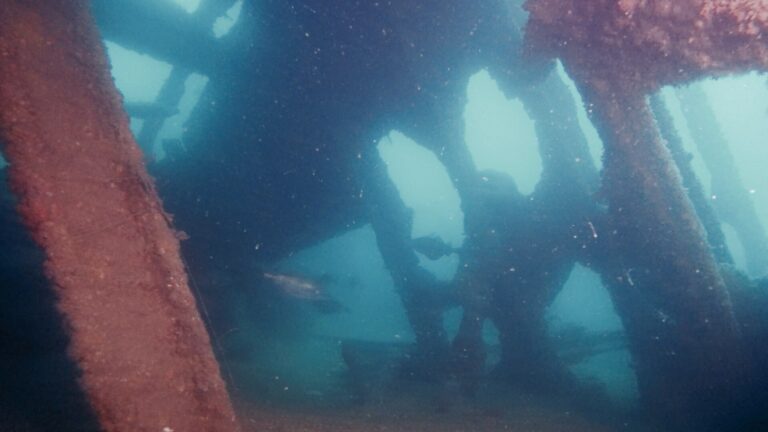
Two of Portland Harbour’s most unusual wrecks, lying in close proximity inside the southern breakwater, are usually dived together via a guide rope. The landing craft is almost completely intact, with its landing doors closed and offers an interesting tour ending at the wheelhouse and exposed engine at the stern. A short swim leads to the Bombardon unit, a WWII experimental wave-breaking device built for the D-Day Mulberry Harbour operations. Its extraordinary X-shaped cross-section creates dramatic valleys of steel you can swim through, and in good visibility, the scale of the structure is genuinely impressive.
Black Hawk Bow
- Depth: 16–18m
- Type: Wreck / Drift
- Level: Sports diver
The Black Hawk was a 7,191-ton US Liberty ship built in 1943, torpedoed on 29 December 1944 while sailing in convoy from Cherbourg to Fowey. Her stern sank in deep water off Kimmeridge, while the bow section was towed towards Worbarrow Bay during salvage operations and now lies in 16–18m. The bow has been scattered by subsequent blasting to allow a pipeline to pass through the bay, but there is still plenty of recognisable structure among the wreckage, and the site attracts a good variety of marine life.
James Fennel
- Depth: 15–18m
- Type: Wreck
- Level: Sports diver
HMT James Fennel was a 215-ton Admiralty trawler built in 1918 that ran aground below the cliffs of Blacknor Fort on 16 January 1920 in thick fog. Fisherman ‘Sunny’ Saunders heroically guided all 16 crew to safety in darkness using a rope strung to shore, though the captain was lost when he fell into the sea. The stern stands almost 5m proud of the seabed with a large propeller, and the engine and boiler are visible amidships, with the smashed bow section twisted but still in contact with the hull. Well known for exceptional sea life, including cuttlefish, conger eels, lobsters, nudibranchs, and the occasional stonefish.
Lulworth Banks
- Depth: 10–22m
- Type: Reef / Wreck / Drift
- Level: Sports diver
A large, varied reef system covering several square miles due south of Durdle Door, varying in depth from around 10m down to a maximum of 22m. Scallops, lobsters and a wide variety of flatfish are regularly encountered, and the reefs provide habitat for crabs, wrasse and nudibranchs. The British Inventor, a WWII oil tanker mined in June 1940, also known as the Scallop Wreck, lies on the banks as a scattered bonus for those who explore further. This is often a planned drift dive.
British Inventor
- Depth: 20–21m
- Type: Wreck
- Level: Sports diver
A British steam-driven oil tanker mined on 13 June 1940, the British Inventor lies on the Lulworth Banks with only the bow section remaining. The rest of the hull was destroyed by the explosion. Known locally as the Scallop Wreck for the remarkable density of scallops that colonise the wreck and the surrounding reef, it also attracts excellent fish life, including the shoals of bib and pollock that greet divers on descent.
Pulpit Rock
- Depth: 5–25m
- Type: Reef / Drift
- Level: Sports diver
One of Portland’s most scenic dive sites, Pulpit Rock sits at the very tip of Portland Bill and offers dramatic underwater topography in the form of gullies, cracks and rugged rock faces. Marine life is prolific thanks to the strong tidal currents that sweep nutrients past the point, and returning crayfish, wrasse, pollock and nudibranchs are all commonly seen. Slack water is essential, and the window is short (around 45 minutes), roughly four hours after Portland high water. If we are diving here, it is essential that we hit slack.
Elena R
- Depth: 28m
- Type: Wreck
- Level: Sports diver with depth progression
A 4,576-ton Greek steamship built in Virginia in 1917, the Elena R struck a mine laid by U-26 on 22 November 1939 on the outer side of the Shambles Bank. Parts of the wreck stand 6m high in places, though the site is subject to the shifting sands and shell of the bank and can vary between dives. Fairly well broken up overall, she lies with her bow to the south-east and has become an extended artificial reef for crabs and lobsters.
Binnendijk
- Depth: 27–28m
- Type: Wreck
- Level: Sports diver with depth progression
The Binnendijk was a 7,000-ton Dutch Holland America Line steamship bound for Rotterdam from New York in September 1939 when she struck a German magnetic mine off the Shambles Bank. She caught fire from stem to stern and sank with all hands rescued. The wreck was subsequently dispersed by explosives and is now well broken up, though substantial hull sections stand up to 6m above the seabed. Sheltered by Portland Bill and the Shambles Bank, it is often diveable when other sites are blown out and provides habitat for lobster, spider crabs, conger eels and tompot blennies. The stern is the most intact section.
Alex Van Opstal
- Depth: 28m
- Type: Wreck
- Level: Advanced
A 5,965-ton Belgian passenger and cargo liner providing a regular service between New York and Antwerp, the Alex Van Opstal was the first victim of U-26’s minefield off the Shambles, sinking on 15 September 1939. The 128m-long hull lies in two sections at 28m, bow detached from the stern, with goalposts of paired masts, cargo winches and hold coamings spread across the seabed. A big, rewarding wreck dive with a lot to explore across a long debris trail. Designated a war grave; treat with respect.
M2 Submarine
- Depth: 30–35m
- Type: Submarine
- Level: Advanced
One of the must-do dives of the south coast, HMS M2 was a unique experimental submarine aircraft carrier and the world’s first converted to carry a small folding seaplane in a watertight hangar forward of the conning tower. She sank with the loss of all 60 crew on 26 January 1932 during exercises off Portland, almost certainly because the hangar door was opened before she had fully surfaced. The 90m-long hull sits upright and largely intact on a sandy seabed at 35m, with the conning tower rising to around 27m. Brightly coloured sponges cover the upper casing, and the seaplane hangar is clearly visible. Slack water is essential. Designated a war grave.
P555
- Depth: 38–41m
- Type: Submarine
- Level: Advanced
Originally a US Navy S-class submarine, lend-leased to the Royal Navy in 1942 and redesignated P555, she served with the 7th Submarine Flotilla at Holy Loch. After suffering collision damage in the Clyde, she was intentionally scuttled by the Royal Navy in 1947 as an ASDIC sonar target. She lies at 38–41m about 12 miles from Weymouth, with the gun-deck and propellers removed before sinking.